“I irrevocably resolve to love and serve Him with greater fidelity and to give myself entirely to Him.”
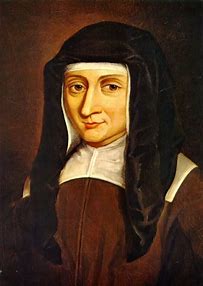
Early Years (1591 – c. 1625)
Louise de Marillac was born on August 12, 1591, near Meux, France. She was the illegitimate daughter of Louis de Marillac, Lord of Ferrières, a nobleman who acknowledged her and provided for her education, though she never knew her mother. From a young age, Louise received an excellent education, first at the Royal Monastery of Poissy under the Dominican Sisters, where she studied art, music, and literature, and later at a boarding house in Paris, where she gained valuable domestic and organizational skills.
At the age of 12, her father died, leaving her in the care of relatives who unfortunately withheld much of her rightful inheritance. This experience of vulnerability and dependence likely shaped her empathy for the less fortunate later in life. She felt an early call to religious life, but her confessor discouraged her from entering a Capuchin convent due to her delicate health and perhaps also her social standing.
In 1613, at the age of 22, Louise entered into an arranged marriage with Antoine Le Gras, secretary to Queen Marie de’ Medici. The marriage, though initially for practical reasons, blossomed into a loving and supportive union, and they had a son, Michel, in October of that same year. Louise was a devoted wife and mother, actively involved in her household and social circles, which included both royalty and the aristocracy. She also began to engage in charitable activities, holding a leadership role in the Ladies of Charity, an organization of wealthy women dedicated to assisting the poor.
Louise suffered from depression that overcame her. She suffered with internal doubt and guilt at having not pursued the religious calling she had felt as a young woman, and she prayed for a resolution. In 1623, at the age of thirty-two, she wrote, “On the Feast of Pentecost, during Holy Mass while I was praying in the Church, my mind was completely freed of all doubt. I was advised that I should remain with my husband and that the time would come when I would be in the position to make vows of poverty, chastity and obedience and that I would be in a small community where others would do the same. I felt that it was God who was teaching me these things and that, believing there is a God, I should not doubt the rest”. She vowed to never remarry should her husband die before her. She was shown the face of a new spiritual director that she would receive. She then met Vincent de Paul and recognized him as that face she was shown. She wrote this “lumière”(“Pentecost experience” of Saint Louise) on parchment and carried it on her person as a reminder that despite her difficulties, God was guiding her life.
Her Works (c. 1625 – 1660)
Louise de Marillac’s life took a definitive turn after the death of her beloved husband, Antoine, in 1625, following a long illness during which she nursed him devotedly. Widowed at 34, and with a son to raise, she now focused intently on her spiritual development. Being a woman of great energy, intelligence, determination and devotion, Louise wrote her own “Rule of Life in the World”, which detailed a structure for her day. It included the Divine Office of the Blessed Virgin Mary, Mass, Holy Communion, Mediation, Spiritual Reading, Fasting, Penance, Reciting the Rosary and special prayers. She still found time to manage her house, entertain guests, and raise her thirteen-year-old son. This led her to a profound and transformative relationship with Saint Vincent de Paul, who became her spiritual guide.
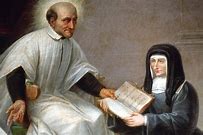
Under Saint Vincent’s guidance, Louise’s innate compassion and organizational talents found their true calling. He initially asked her to visit and reorganize the Confraternities of Charity (later known as the Ladies of Charity) in rural parishes. These groups, composed of aristocratic women, were struggling to provide effective and consistent care to the poor due to their own domestic and social commitments. Louise’s travels throughout France, observing the dire conditions and the limitations of existing charitable efforts, deepened her understanding of poverty and the need for dedicated, systematic service.
Recognizing the need for a new type of religious community – one that was “open to the world” and not confined to cloistered monasteries – Louise and Saint Vincent de Paul co-founded the Daughters of Charity of Saint Vincent de Paul on November 29, 1633. The Daughters of Charity were unlike the established Religious Communities at the time; up to this point all religious women were behind cloister walls and performed a ministry of contemplative prayer. In working with her sisters, Louise emphasized a balanced life, as Vincent de Paul had taught her. It was the integration of contemplation and activity that made Louise’s work so successful. She wrote, “Certainly it is the great secret of the spiritual life to abandon to God all that we love, by abandoning ourselves to all that He wills”. This innovative community of women committed themselves to serving the sick, poor, and neglected, living simple annual vows and working directly among those in need. Louise became the first Superior of the Daughters of Charity, dedicating herself to their formation, training, and spiritual guidance.
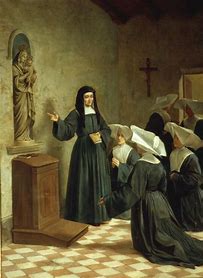
Under her leadership, the Daughters of Charity expanded rapidly and established groundbreaking institutions and services:
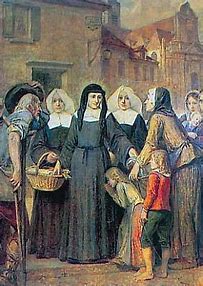
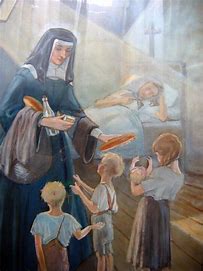
- Hospitals and Home Nursing: They provided systematic care for the sick in their homes and established community hospitals.
- Schools and Orphanages: They opened schools for poor children and homes for abandoned infants and orphans.
- Care for the Elderly and Prisoners: They extended their service to the aged poor and worked to improve conditions in prisons.
- Job Training: They offered vocational training to help the poor become self-sufficient.
- Mental Health Care: They were among the first to address the needs of those with mental illness.
Louise’s administrative skills, deep spiritual insight, and tireless dedication were critical to the success and expansion of the Daughters of Charity. She traveled extensively, establishing new houses and overseeing the formation of the sisters, all while maintaining a vast correspondence and nurturing her own spiritual life. By the time of her death, the congregation had grown to over 40 houses across France.
Her Death and Beatification
St. Louise de Marillac’s health, often fragile, deteriorated in her later years. She died on March 15, 1660, in Paris, just six months before her beloved mentor and collaborator, Saint Vincent de Paul. Her last words to her Daughters of Charity were: “Take good care of the service of the poor. Above all, live together in great union and cordiality, loving one another in imitation of the union and life of our Lord. Pray earnestly to the Blessed Virgin, that she might be your only Mother”
The process for her beatification began following her death. She was beatified by Pope Benedict XV on May 9, 1920, and canonized by Pope Pius XI on March 11, 1934. In 1960, Pope John XXIII proclaimed her the Patroness of all Social Workers, recognizing her pioneering efforts in organizing and professionalizing charitable service. Her feast day is celebrated on May 9.
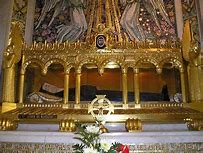
Quotes from St Louise de Marillac
“I know that we all have faults and I more than anyone. However, the support we owe to one another should prevent us from noticing the weaknesses of our sisters, except if we are able to help them.”
“I hope that your gratitude will place you in the disposition necessary to receive the graces you need to serve your sick poor in a spirit of gentleness and great compassion, in imitation of Our Lord who acted this way with the most unfortunate.”
“I have no doubt that God will bless this work provided we place no obstacles in His way. We shall always try to act with trust and dependence upon His divine will.”
“I believe that you work with one another to grow in perfection in keeping with the divine plan. All the actions of our lives can serve this purpose even those which might appear destined to withdraw you from that intimate union with God which you so ardently desire. Very often this union is established in us through no action of our own in a manner known only to God and not as we would wish to imagine it.”
“I beg you for the love of God to show great tenderness to the poor.”
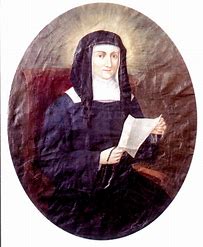
“I gave myself to God to accept the designs of His Providence if He willed me to continue, for the remainder of Lent, in a state of interior abandonment and even affliction so as to honor the sufferings of Jesus Christ which the Church places before our eyes.”